There are 3 type of Loops in C language
- while loop
- for loop
- do while loop
while loop :
while loop can be addressed as an entry control loop. It is completed in 3 steps.
- Variable initialization.( e.g int x=0; )
- condition( e.g while( x<=10) )
- Variable increment or decrement ( x++ or x-- or x=x+2 )
Syntax :
variable initialization ;
while (condition)
{
 statements ;
 variable increment or decrement ;
}
Example : Program to print first 10 natural numbers
#include<stdio.h>
#include<conio.h>
void main( )
{
 int x;
 x=1;
 while(x<=10)
 {
   printf("%d\t", x);
   x++;
 }
 getch();
}
output
1 2 3 4 5 6 7 8 9 10
for loop :
for loop is used to execute a set of statements repeatedly until a particular condition is satisfied. we can say it an open ended loop. General format is,
for(initialization; condition ; increment/decrement)
{
  statement-block;
}
In for loop we have exactly two semicolons, one after
initialization and second after condition. In this loop we can have more
than one initialization or increment/decrement, separated using comma
operator. for loop can have only one condition.
Above Example with for loop
#include<stdio.h>
#include<conio.h>
void main( )
{
 int x;
 for(x=1; x<=10; x++)
 {
   printf("%d\t",x);
 }
 getch();
}
Output
1 2 3 4 5 6 7 8 9 10
Nested for loop :
We can also have nested for loops, i.e one for loop inside another for loop. Basic syntax is,
for(initialization; condition; increment/decrement)
{
  for(initialization; condition; increment/decrement)
     {
        statement ;
     }
}
Example : Program to print half Pyramid of numbers
#include<stdio.h>
#include<conio.h>
void main( )
{
 int i,j;
 for(i=1;i<5;i++)
 {
   printf("\n");
   for(j=i;j>0;j--)
   {
     printf("%d",j);
   }
 }
 getch();
}
output
1
21
321
4321
54321
do while loop :
In some situations it is necessary to execute body of the loop before
testing the condition. Such situations can be handled with the help of do-while loop. do statement evaluates the body of the loop first and at the end, the condition is checked using while statement. General format of do-while loop is,
do
{
 ....
 .....
}
while(condition)
Example : Program to print first ten multiple of 5.
#include<stdio.h>
#include<conio.h>
void main()
{
 int a,i;
 a=5;
 i=1;
 do
 {
   printf("%d\t",a*i);
   i++;
 }
 while(i <= 10);
getch();
}
output
5 10 15 20 25 30 35 40 45 50
Jumping Out of Loops
Sometimes, while executing a loop, it becomes necessary to skip a part
of the loop or to leave the loop as soon as certain condition becomes
true, that is called jumping out of loop. C language allows jumping from
one statement to another within a loop as well as jumping out of the
loop.
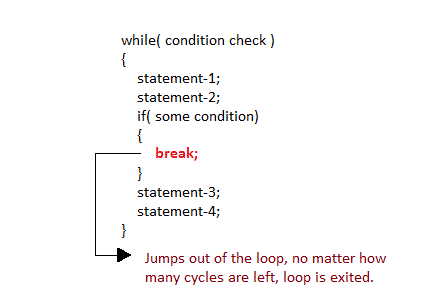
1) break statement
When break statement is encountered inside a loop, the loop is
immediately exited and the program continues with the statement
immediately following the loop.
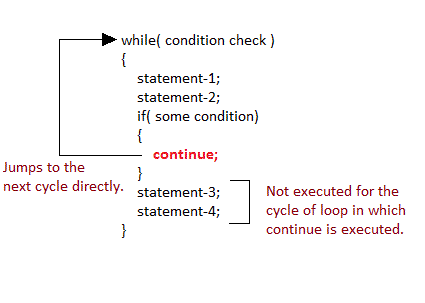
2) continue statement
It causes the control to go directly to the test-condition and then
continue the loop process. On encountering continue, cursor leave the
current cycle of loop, and starts with the next cycle.

No comments:
Post a Comment
Thank for your feedback.